
By Pérez Gallo
I took part, somewhat by chance, in the demonstration in Milan on September 22, which had wide international repercussions due to the violent clashes with the police that took place at the entrance to the Central Railway Station. I was in Germany during the previous week, where I was attending an academic event and, being originally from Italy, I decided to extend my trip a few more days in Milan, to visit friends and family. I arrived on the evening of Friday, the 19th, and it soon seemed to me that the mood was different from the usual – more tense, in expectation. The Palestinian genocide, in fact, is a powerful theme in the Italian debate, either because of the presence of an important Arab and Palestinian community in the territory or because of the geographical and geopolitical proximity. But also – I believe – because hopes have converged in recent years on the Palestinian issue for the resumption of some movement after more than a decade of ebb and flow of struggles. The retreat that in Milan feels even stronger: a city completely dominated by gentrification and real estate speculation, by the great fashion events and gourmet food fairs, by the increase in urban transport and an economic rhythm (and exploitation) in full swing. And where, for a long time, social struggles have been something kind of absent from the horizon of urban life.
On the 19th, just as I was returning from the airport, there was a small demonstration and work stoppage organized by the CGIL, the largest trade union confederation, in solidarity with Gaza. Contrary to what one might think, the CGIL decision was not the brave choice to organize a political strike, but the cowardly attempt to recover the struggle, advancing the strike that had already been scheduled for the 22nd by the grassroots unions USB, Cobas, ADL Cobas, CUB, SGB, under the impulse of the Genoa Port Workers collective. The idea would be to make a stoppage of only two hours, on a Friday afternoon, and not adhere to — and in this way weaken — the other strike scheduled for the whole Monday (a day in which a blockade would do much more damage). The maneuver, apparently, did not work out. Throughout the weekend, people around me — even many of my acquaintances who hadn’t participated in a demonstration in 15 years – kept talking about the upcoming event on the 22nd. Rain was forecast, and this raised some doubts about the success of the mobilization.
On Monday morning, in fact, the rain was intense and constant. Despite this, when I arrived in Piazza Cadorna a little before the scheduled time for the concentration, you could tell that the demonstration would be huge. Thousands of people were gathering there under umbrellas, to the point that when the front of the demonstration began to move, people were still arriving in the square. The demonstration, with more than 50,000 people, marched in a confused way for almost 5 kilometres to the Central Station, not before making a detour to pass in front of the United States Consulate, where the flags of the United States, Israel, the European Union and NATO were burned. What surprised me, perhaps because I had been away from Italian protests for many years, was its political composition, that is, not the division into blocks organized by the entities and the social centers, but rather a long heterogeneous and indefinite human serpent, all behind a single sound truck of the USB union, in which the social composition was mixed: students and retirees, Arab immigrants, young secondary school students from the periphery and families with children, workers and middle class, and here and there small groups that made some specific intervention, such as a group of fanfare or healthcare workers under the banner of “healthcare workers for Gaza”. In general, it also seemed to me a not-so-loud demonstration, almost silent at times, as if the lack of a sound speaker left more room for the atrocious emptiness of the moment we are living in.
View this post on Instagram
Milan demonstration seen from above.
When we arrived, around 1 p.m., in the Central Station Square, the general feeling was one of strangeness: the demonstration seemed to be over, but we had not yet blocked anything, while news arrived of occupations of stations, highways, and ports in other cities. The police had a huge contingent lined up for the defence of the station, and it seemed crazy to try to challenge them, apart from the fact that no group seemed to be organised for such. Little by little, however, frustrations and expectations were leading a group of people down the stairs of the subway, from where they would have a passage to the station by underground. Just below, however, was another police contingent. The pressure was building until we managed to get to the bottom of the station thanks to a lot of shouting and some pushing. From there, however, to occupy the tracks, we had to go up to another floor by an escalator, above which the confrontation began, and continued through the glass doors of the station hall, defended by the police and destroyed by the protesters. Finally, the police began throwing tear gas canisters, many at face height. The battle lasted an hour and a half inside the station, plus a couple of hours in via Vittor Pisani, the large avenue outside the station, with the police advancing and the crowd resisting, without retreating, throwing stones and other objects. Although it did not reach the tracks, for a long time the station was closed, with the trains, already accumulating delays of more than two hours due to the strike, stopping for some time instead of passing through the station. From what I read afterwards, the participation in the most heated clashes was of a thousand people, with as many supporting from the outside. The toll was 60 police officers injured, with 24 hospitalised, 11 protesters detained (including two minors), and about ten taken away by ambulance. I was really surprised by the disposition of the crowd: I do not remember, since I was a teenager, a demonstration with such lengthy and at the same time unprepared confrontations. In the past, the most common were “performative” confrontations of the crowd from the ex tute bianche, with a little melee from the first lines with the police to have a photo in the media and then retreat, or moments of a more planned riot, with burning of cars during the demonstration by a smaller group but completely disconnected with the general feeling of the crowd, as occurred in the large “No Expo” demonstration of May 1, 2015. From there, the desert.
View this post on Instagram
Videos of the confrontation
If Milan, due to its violent outcome, was the centre of the news and images that passed through the media and social networks — and obviously echoed by Prime Minister Giorgia Meloni, who at no time attacked the Israeli barbarism in Gaza with the same harshness that she dedicated to the “Milan vandals” —, in the rest of Italy the struggles were also giant. According to the union USB, more than 1 million people in 84 cities participated in the demonstrations.
In Rome, 200 to 300 thousand people marched for 8 hours, for 10 kilometres, through the streets surrounding the Termini Station (the largest in the city), causing a momentary blockade of rail traffic, and occupying the university campus of La Sapienza and the Eastern Ring Road for hours in both directions. There, many drivers stopped in traffic didn’t react with anger but with applause, horns, and demonstrations of complicity.
Drivers’ support for the demonstration
View this post on Instagram
Demonstration in Rome seen from above
Another huge demonstration happened in Bologna, with 50,000 people filling the streets of the centre to later occupy the Ring Road, where there was a police crackdown with four people arrested.
View this post on Instagram
Demonstration in Bologna
Clashes on the Ring Road in Bologna
Demonstrations with 15 to 20 thousand people also took place in Naples and Turin (where the railway station was occupied); Genoa (with the occupation of the port); and in Venice, where the social centres of the Northeast blockaded Porto Marghera and had clashes with the police, who made use of water jets.
Venice
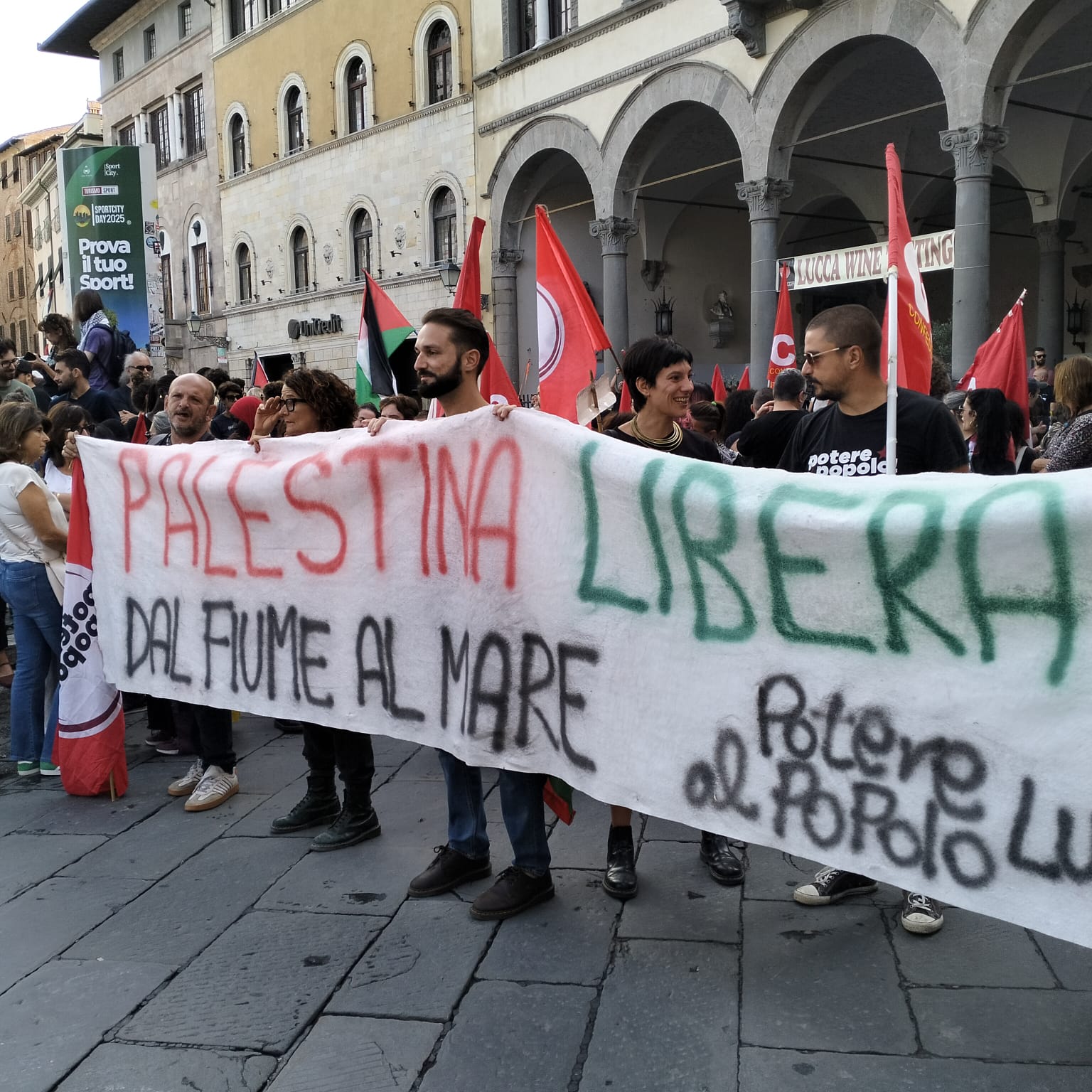
Other clashes and arrests took place in Brescia as 10,000 protesters attempted to occupy the railway station after blocking the city’s Metro, while a similar number of people paraded in Palermo, Florence, and Pisa. In the latter city, protesters managed to block the bus station, the train station and even the Firenze-Pisa-Livorno Highway. Five thousand people took to the streets in southern cities such as Cagliari, Catania, and Bari. There were also blockades and disruptions at other major port terminals such as those in Trieste, Ravenna, Ancona, Civitavecchia and Salerno. In Livorno, the blockade of the Valessini terminal turned into a permanent protest aimed at the next day, when the passage of a US cargo ship bound for Israel was expected.
As a whole, the journey was undoubtedly successful and surprising. Surprisingly, in the first place, because Italy had stayed away from the last cycles of global upheavals. Social movements are totally fragmented, and what has prevailed among comrades in recent years is a constant sense of disillusionment and impotence, feelings heightened in recent times by the rise of a far-right government. Since the beginning of the genocide in Palestine, the occupations on university campuses have shown a certain reactivation of the youth composition, certainly dominant also in the demonstrations of Monday, but extremely reduced in demographic terms in what is the second-oldest country in the world. At the same time, under the impetus of the small Palestinian youth organisation, protests in solidarity with Gaza have acquired a certain frequency, becoming, in the case of Milan, even weekly, with some small demonstrations that take place every Saturday. Possibly, the departure of the global Sumud Flotilla must have given some inspiration, as well as the French “let’s block everything” movement that has emerged in recent weeks against Macron’s policies. Perhaps the outrage has crossed some threshold with the escalation of the “final solution” to the Palestinian Holocaust set in motion by Israel in recent months. Perhaps the Palestinian issue has become the unifying theme of a set of diffuse social dissatisfaction. Maybe it is, today, “the name of our discontent”.
The demonstrations were undoubtedly successful, but above all, the strategic choice to block the main communication routes. Very quickly, from the blockades of the docks of the ships loaded with weapons and ammunition to directly supply the Israeli army, the understanding came that all the logistics of war are inseparable from the logistics of global capitalism in this destructive stage. If the bottlenecks of transport and communications of goods and people make up the material skeleton of the global economy, the understanding arose that it is from there that it would perhaps be possible to exercise some kind of “counterpower” to fascist barbarism.
Less successful, however, was the result of the stoppage in the strict sense. Faced with the convergence between the obvious difficulties of carrying out a “political” strike (in fact, this was the first experience since the genocide in Gaza began) and the cowardice of the CGIL and the other major trade union confederations, which has hegemony of affiliates in production and public employment, the participation rate seems to have been below 10% in many sectors, with probable exceptions in the public education sector and in some sectors of the circulation, which in some cities joined en masse. This opens up many questions about whether it is possible to paralyse economic life without the mass participation of the organised working class, but manage to hit the main bottlenecks of the global economy. At a time when wage pressure, unemployment, blackmail in the workplace, job insecurity and coward union leaders make it more difficult to effectively exercise the instrument of the strike, to what extent can a very effective revolt itself become a form of general stoppage?
But the main question, here and now, is whether this new movement will have the strength and the capacity to move forward, to grow, to put in crisis a Meloni government that so far still sails with some degree of consensus, and above all to spill over to other countries to make a real contribution to ending the ongoing genocide. As announced by the Genoa Port Workers collective, the current strike was launched as a rehearsal for the moment when there would be some kind of aggression against the Global Sumud Flotilla, which is approaching the Gaza Strip. If this happens, the dock workers have already threatened that they will not carry “not even a nail” and would stop “the whole of Europe”. Time will tell. For now, we are left with the feeling that, for once, we have raised our heads, we have overcome resignation. Maybe it’s just a flash, a feeling that, together in the streets, we can still feel alive. That we can still shout, even if it makes almost no sense given the level of the present tragedy, that “the peoples in revolt write their history, intifada until victory!”